
Universidad Estatal de Bolívar, Facultad de Ciencias Agropecuarias
Recursos Naturales y del Ambiente, 020150, Guaranda (Ecuador)
Corresponding Author Email:: fbayas@ueb.edu.ec
Article Publishing History
Received:
Accepted After Revision:
This research was carried out in the city of Guaranda (Ecuador). The objectives set out in this work were: to establish the best fermentation time of the mucilage and to determine the best percentage of yeast and fermentation time. For which, the experimental material used was cocoa mucilage from two varieties of cocoa (Nacional and CCN51). A 2x3x3 factorial design with two repetitions was applied. The functional analysis was based on a 5% Tukey test to compare treatment means. After having carried out the sensory evaluation of the attributes; taste, smell, aroma, texture and acceptability and when comparing the treatments, the panelists valued the treatments T6 (A1B2C3) and T15 (A2 B2 C3) as better. The two best treatments were characterized by physicochemical analysis, finding values within the parameters established in the INEN 362 control regulations.
Alcoholic Drink, Mucilage, Cocoa.
Tigre L A, Velarde-Escobar K, Bayas-Morejón F. Aerobic Fermentation Of Cacao Mucilage (Theobroma cacao L.) to Obtain A Wine-Type Beverage. International Journal of Biomedical Research Science (IJBRS). 2026;02(2)
Tigre L A, Velarde-Escobar K, Bayas-Morejón F. Aerobic Fermentation Of Cacao Mucilage (Theobroma cacao L.) to Obtain A Wine-Type Beverage. International Journal of Biomedical Research Science (IJBRS). 2026; 02 (2). Available from: <a href=”https://shorturl.at/ufv6S“>https://shorturl.at/ufv6S</a>
INTRODUCTION
Cacao is a long-established crop in Ecuador, having been cultivated since before the arrival of the Spanish. It gained significant importance, as in some areas it was used as currency due to its high value. Of all the cacao varieties, three are considered the most important: Criollo, Extranjero, and Trinitario [14]. Global cacao production is concentrated primarily within 10 degrees north and 10 degrees south of the equator. Originating in South America, cacao first appeared in Spain thanks to Hernán Cortés in 1528. To satisfy the demand of the Spanish classes, the first attempts at plantations were undertaken in the Caribbean, without success, and later, particularly in Ecuador around 1635, by the Capuchin friars [16].
Consequently, with the industrialization of cacao, various byproducts or derivatives are obtained, among which the following stand out: cacao powder, chocolate, and cacao liquor. In the latter case, globally, regarding the overall significance of the production of derivatives of the product under study (cacao), levels are reached by addition, meaning that the derivative itself is not widely used in its specific form [4]. In Ecuador, cacao is the third most important non-oil traditional export, accounting for approximately 70% of the world’s fine aroma cacao production [1]. The mucilage, or pulp, decomposes into liquid substances during the cacao fermentation process. During fermentation, the mucilage or pulp decomposes into liquid substances. The sugar in the pulp is transformed first into alcohol and then into acetic acid. Much of the pulp escapes as an exudate. The alcohol concentration in the exudate is approximately 2-3%, and the acetic acid concentration is 2.5%. The total dry matter content of the exudate is around 8%, with a crude protein content of approximately 20%. The total volume of exudate is considerable, but no practical use has been found [3]. Considering the above, the objective of this work was to utilize cocoa mucilage by producing a fermented alcoholic beverage.
MATERIALS AND METHODS
This research work was carried out at the processing plant of the agro-industry career of the State University of Bolívar (Guaranda-Ecuador), for which, cocoa mucilage obtained from cocoa pods grown in the Las Naves canton was used as raw material.
Raw Material Analysis: The mucilage underwent analysis including Brix degrees according to INEN-273 and pH analysis according to INEN 389.
Alcoholic Beverage Production Process: The mucilage was transported in 1L plastic containers, which had been previously frozen to prevent fermentation. The alcoholic beverage was formulated according to the following combination of factors (Table 1).
Table 1. Combination of factors in the experimental design for obtaining the alcoholic beverage.
| Methods | Factors | Levels |
| Cocoa variety | A | A1: NativeA2: CCN51 |
| Washing percentage | B | B1: 0%B2: 5%B3: 10% |
| Fermentation time | C | C1: 5 daysC2: 10 daysC3: 15 days |
The experimental design applied was: 3x3x3 factorial design with 2 repetitions.
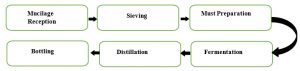
The experimentation was carried out according to the following diagram:
Figure 1: Diagram of the process of obtaining the alcoholic beverage.
Analysis in alcoholic beverage: In the product obtained, the pH (INEN-389), alcoholic level (INEN-340) was analyzed, a sensory analysis was also carried out to determine the acceptance of the product, for which a group of 10 tasters were semi-trained, where the parameters analyzed were: smell, flavor, color, acceptability of the drink.
Physical-chemical analysis the best treatment: In the best drink, analyzes were carried out such as: determination of acidity (INEN-341) and determination of methanol (INEN 347).
Statistical analysis: To determine the best treatment, the test of means was applied, and for this specific case the Tukey test was used at 5% (confidence level).
RESULTS AND DISCUSION
In the raw material, the °Brix and pH results show that the Nacional cacao variety obtained 15.3 °Brix and a pH of 4.1, while the CCN-51 cacao yielded 14.2 °Brix and a pH of 4.2. In both cases, the pH values were acidic, primarily due to the presence of citric acid [3]. Lower pH results were obtained in other studies conducted in Ecuador by [15] and [2], with 3.79 and 3.58, respectively. pH values below 4.5 and a high content of total soluble solids, with values around 14–18 °Brix, promote the growth of microorganisms involved in fermentation [11,[12].
Analysis of the finished product: The finished product underwent analyses such as: yield, pH, alcoholic content and sensory evaluation.
Performance
DSM = 8.94
Figure 2: Average values for the performance of the alcoholic beverage.
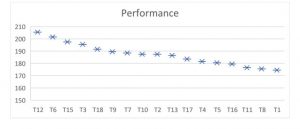
Regarding the performance tests, for the comparison of means by the Tukey method at a 5% significance level, it can be observed that there are highly significant differences, with the best treatment being T12 corresponding to levels (A2B1C3) to the mucilage of cocoa variety CCN-51, 0% yeast at 15 days of fermentation, followed far behind by treatments T6 and T15.
Figure 3: pH of the alcoholic beverage obtained.
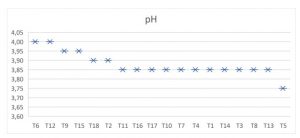
In the pH tests, for the comparison of means (Tukey 5%), it is observed that there are significant differences, with T6 corresponding to the levels (A1B2C3) of the mucilage of the National variety, at 5% yeast at 15 days of fermentation.
Figure 4: GL of the alcoholic beverage obtained.
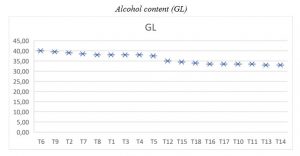
Regarding the GL tests, for the comparison of means (Tukey 5%), it is observed that there are significant differences between the treatments, with T6 (A1B2C3: mucilage of the National variety, at 5% yeast at 15 days of fermentation) having a higher CG value than the other treatments.
Sensory evaluation: Regarding the averages obtained by the tasters, but in accordance with the aforementioned standards, it should be noted that: -All alcoholic beverages must have the characteristic color, aroma, and flavor of the fruit from which they originate, considering the analytical parameters that were determined. The treatments with the highest acceptability among the tasters were T6 (A1B2C3: mucilage of the Nacional variety, 5% yeast after 15 days of fermentation) and T15 (A2B2C3: mucilage of the CCN51 variety, 5% yeast after 15 days of fermentation).
Analysis of the best treatment.
Table 2. Physicochemical analysis of the best treatment
| Parameter | Unit | T6 (A1B1C3) | T15 (A2B2C3) |
| pH | – | 3.7 | 4.1 |
| Temperature | °C | 17.5 | 20.5 |
| Alcohol content | % (v/v) | 40 | 36 |
| Titratable acidity | % | 0.74 | 0.43 |
| Methanol | – | Negative | Negative |
CONCLUSION
In the physicochemical analyses of the best liquor (T6 and T15), it can be observed that the pH of the CCN-51 variety is 4.1, while the pH of the national variety is 3.7. These results indicate that they are acidic. In a study conducted by Thanh Tinh et al. (2016) on a cocoa mucilage liquor wine, a pH value between 4 and 4.1 was obtained. The alcoholic strength of the cocoa mucilage from the CCN-51 variety was 20.5%, while the alcoholic strength of the cocoa mucilage from the national variety was 40%. These results indicate that they are acceptable for consumption. The titratable acidity of the cocoa mucilage from the CCN-51 variety was 0.43, while the titratable acidity of the cocoa mucilage from the national variety was 0.74. These results indicate that they are within the ranges according to the INEN 362 standard, the ranges allowed in alcoholic degrees are between 15 to 85 °GL; titratable acidity of 40 mg/100 cm3 and methanol of 10 mg/100 cm3 of alcohol. It is important to highlight that this is the first time that regulated factor comparison parameters have been used to obtain a fermented beverage from cocoa mucilage in Ecuador.
REFERENCES
- Cacao ecuatoriano fue galardonado en dos categorías en el Salón de París (en línea). Quito, Ecuador. 2011. Consultado 20 dic 2011. Disponible en http://www.anecacao.com/
- Balladares, C., Chóez-Guaranda, I., García, J., Sosa, D., Pérez, S., González, J., Viteri, R., Barragán, A., Quijano-Avilés, M., Manzano, P. (2016) Physicochemical characterization of Theobroma cacao sweatings in Ecuadorian coast. Emirates Journal of Food and Agriculture, 28(10): 741-745. DOI: 10.9755/ejfa.2016-02-187.
- Loureiro, G., Reis de Araujo, Q., Valle, R., Andrade, G., Moreira, S. (2017). Influence of agro- environmental factors on the quality of cacao (Theobroma cacao ) clone PH-16 in the cacao region of Bahia, Brazil. Ecosist. Recur. Agropec, 4(12): 579-587. DOI: 10.19136/era.a4n12.1274.
- MAGAP (Ministerio de Agricultura, Acuacultura y Pesca, Ecuador). Agrocadena de cacao y elaborados – Panorama 2011; Consultado 20 dic 2011. Disponible en http://www.magap.gob.ec/sinagap/charts/cacao_panoramaint.htm
- NTE INEN 0273. (1990) Determinación de la densidad en grados Brix. Pages
- Identifier-ark ark:/13960/t8jd65t25
- NTE INEN (1994) (Spanish): Bebidas alcohólicas. Determinación del grado alcohólico, pages 17. http://studylib.es/doc/5147131/nte-inen-0340–bebidas- alcoh%C3%B3licas.-determinaci%C3%B3n-del-grado.
- NTE INEN 0341 (1978): Bebidas alcohólicas. Determinación de la acidez, Identifier nte.0341.1978.
- NTE INEN 0347 (1978): Bebidas alcohólicas. Determinación del metanol, Identifier nte.0347.1978
- NTE INEN 0389 (1986): Conservas Determinación de la concentración del ión hidrógeno (pH), pages 7. Identifier-ark ark:/13960/t6vx1p202
- Penha, E.M., Matta, V.M. (1998). Caracteristicas Fisico-químicas e microbiológicas da polpa de Pesquisa Agropecuária Brasileira. 33: 1945-1949.
- Puerari, , Karina, T.M., Schwan, R.F. (2012). New cocoa pulp-based kefir beverages: Microbiological, chemical composition and sensory analysis. Food Research International, 48 (2): 634-640.
- Thanh Tinha, T., Nguyen, T.A., Ho, T.T., Nguyen, T.T. (2016). A study of wine fermentation from mucilage of cocoa beans (Theobroma cacao ) Dalat University Journal of Science. 6; 3: 387–397.
- UNIDA, Unidad de investigación y desarrollo en alimentos (2009).
- Villagómez, S and Argüello, (2013). Optimización y aprovechamiento del residuo (exudado del mucílago) de la almendra fresca del cacao (Theobroma cacao L.) CCN51 en la elaboración de vinagre. Tsafiqui – Revista de Investigación Científica UTE, 4: 1-12.
- ZONADIET. (2011). Bebidas alcohólicas destiladas (en línea). http://www.zonadiet.com/bebidas/destilacion.htm