
1Department: Science Laboratory Technology, Federal University of Petroleum Resources, Effurun
Delta State Chemistry Department, Federal University Lokoja. Kogi State, Anyigba, Nigeria
2Department of Industrial Chemistry, Federal University Lokoja. Kogi State Anyigba, Nigeria.
Corresponding author email: oforobianuju@yahoo.com
Article Publishing History
Received:
Accepted After Revision:
The mechanical effects on polypropylene polymer hybrid materials of two types of micro sieved particles of periwinkle shell filler loading 150µm and 75 µm reinforced with polypropylene polymer matrix by injection molding techniques were investigated. The effects of bio-waste /polymer matrix composite were determined on mechanical parameters (tensile strength, flexural strength and compressive strength) the tests were carried out using America Society for Testing Material (ASTM) and Universal Testing Machine (UTM) 5569A of various standard on the properties of the blended bio-waste filler composites at 150 µm sieved size particle on tensile strength, flexural strength and compressive strength showed higher and better strength than 75 µm sieved size particle of periwinkle shell filler. The study has define abundant contributions of biodegradable natural fillers that promote formation of new classes of biodegradable composites and products with lower cost, light weight, high specific strength, flexibility, stability, availability and satisfactory behavior required in many appliances the research has also expand on a new area of bio-waste management for sustainable economy creating job opportunities in industries.
Periwinkle Shell, Polypropylene, Polymer, Composites, Tensile, Flexural, Compressive,
Micro Sieved (150µm And 75 µm) Particles.
Ofor H. O, Ejike O, Moses O. Comparative Survey on Effects of Mechanical Properties of Polypropylene Polymer Hybrid Material Using Periwinkle Shell. International Journal of Biomedical Research Science (IJBRS). 2026;02(2)
Ofor H. O, Ejike O, Moses O. Comparative Survey on Effects of Mechanical Properties of Polypropylene Polymer Hybrid Material Using Periwinkle Shell. International Journal of Biomedical Research Science (IJBRS). 2026; 02 (2). Available from: <a href=”https://shorturl.at/cUarL“>https://shorturl.at/cUarL</a>
INTRODUCTION
Polymer hybrid materials represent a burgeoning field of research at the intersection of polymer science, materials engineering, and nanotechnology. Over the past few decades, extensive efforts have been devoted to exploring the synthesis, characterization, properties, and applications of these multifunctional materials.
The aim of the this research are to perform a thorough literature review to learn about the most recent advancements and new directions in the field of polymer hybrid materials; synthesis strategies, characterization approaches, and industrial applications by utilizing a variety of mechanical analytical methods and characterize the produced polymer hybrid materials to clarify their structure-property relationship and evaluate their performance. Application: Utilized in advanced composites for electronics, medical devices, packaging materials, biomedical devices, and 3D printing filaments and high-performance materials.
MATERIALS AND METHOD
Sample Collection: Periwinkle shells were collected from the surroundings riverine area in southern Nigeria where they have been dumped after usage. Commercial original polypropylene (pp) polymer matrices were purchased from one of the petrochemical’s company in Nigeria.
List of Equipment’s and The Model: The equipment’s used were Monsanto Tensiometer , weighing balance, ventilated oven , 150µm and 75µm mechanical sieve and universal testing machine (UTM) 5569H (JJLIO4D, London, United kingdom, capacity 1.20KN) in accordance with ASTM D638 for flexural strength, ASTM D570, Tensile strength ASTM D570. Zinc stearate was used as a protective incorporated.
Pretreatment of Bio-Waste (Washing and Drying): Periwinkle shells were washed with clean water sundried and then were broken into pieces with mechanical grinding mill machine. The broken pieces were then grinded to produce fiber powder and then they were separated with 150 µm and 70 µm mechanical sieves to get the particles forms
Chemical Treatment and Preparation of Bio-Waste Fillers with (NaOH): Inside a beaker, 3gm of NaOH was added into 97ml of distilled water to make solution. After adequate drying of the fillers (fibers) for 2-3hrs, the fibers were soaked into the prepared NaOH solution. The fibers were then taking for injection moulding and the particles side sieve of the fillers used 150 µm and 75 µm sieve at 5WT% of periwinkle shell filler, and 95WT% of polypropylene were blended in injection molding to produce the composite . Zinc stearate was used as protective incorporated coated into polymer matrix composite to prevent adhesion to the plastic surface and it was mixed into resin for injection molding, polymer matrix composite was placed between them and then then mold was closed , heat and pressure was applied to obtain homogenous composite. A preheating time of about 1hour at 120ºc was needed for molding and 30minutes for pulling to get the solid molding. Rapid cooling was applied at the end of the moulding time. After processing, specimens were cut into desire sizes and shapes before the characterization of the sample each of the experiment was carried out severally in other to obtain accurate data.
Parameters Determined: Analysis was carried out on the formulated polymer composite to determine their mechanical properties such as tensile strength, flexural strength, and compressive strength. All the test were carried out using international standard such as American society for Testing Material (ASTM), Standard universal testing machine (UTM) 5569A was suitable for many mechanical test of polypropylene matrix composites, the composites containing 5WT% fillers of periwinkles shell and 95WT% of polypropylene at 150 µm and 75 µm sieved particles were prepared and the mechanical properties were examined .
Tensile Strength Test: The tensile strength test is a measurement of elasticity. This test was applied to observe the strength of polymer matrix composite, the tensile strength is the most common procedure for studying the stress-stain relationship. A dog bone- shape specimen was prepared according to international standard (ASTMD638) and the equipment used was tensiometer. After the procedure, the sample data was calculated to obtain the tensile strength of the polymer matrix composite as maximum force divided by cross sectional area.
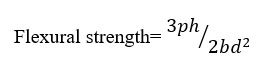
Where P= maximum load applied
L= length of the sample (300mm2)
B= width of the sample (19mm2)
D= depth of the sample (3.2mm2).
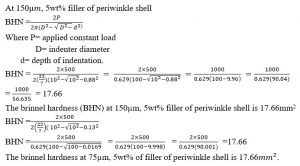
Brinnel Hardness Test: Hardness test is a mechanical property of the material that can be described as the resistance of the material to localize deformation or measurement of toughness. For this test, ASTMD785 method and Monsanto tensiometer equipment with sample size 20×20× dimension were employed for measuring the hardness. After the procedure, the sample data was calculated to obtain the brinnel hardness number (BHN) of the polymer matrix composite using the expression.
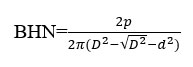
Where P = constant chosen load
D= Brinnel bold diameter
d = depth of indentation.
BHN= Brinnel hardness number (N∕mm2)
RESULTS AND DISCUSSION
The sample results generated from periwinkle shells used in the study were processed and sieved to 75µm and 150µm with 95%wt of polypropylene(pp) used in compounding the composite in an injection molding machine. The resulting composite were extruded as rectangular sheets. The sheets were dimensioned into the following measurement in accordance with ASTM standard for measuring some mechanical properties.
(160×19×19×32)mm ..…….. tensile testing
(300×19×3.2)mm……….flexural testing
(20×20×20)mm………..hardness measurement.
Tensile strength
Table 1a. At 150 , 5wt% filler of periwinkle shell
| P(N) | 0.00 | 200 | 400 | 1000 | 1500 | 1900 |
| Ext(MM) | 0.00 | 0.50 | 1.00 | 1.45 | 2.43 | 3.10 |
Table 1b: At 75 m, 5wt% filler of periwinkle shell
| P(N) | 0.00 | 200 | 500 | 800. |
| Ext(mm) | 0.00 | 0.38 | 0.75 | 1.00. |
At 150µm,5wt% filler of periwinkle shell
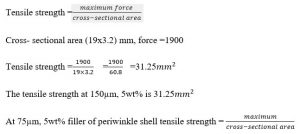
Cross –sectional area (19×3.2) mm, force=800.

The tensile strength at 75µm, 5wt% 0f filler is 13.16mm2
Flexural Test
Table 2a. At 150µm, 5wt% filler of periwinkle shell
| P(N) | 0.00 | 12.50 | 37.50 | 56.30 | 56.30 |
| Deflection(mm) | 0.00 | 0.50 | 1.00 | 2.25 | 2.62 |
Table 2b: At 75µm, 5WT% filler of periwinkle shell
| P(N) | 0.00 | 6.46 | 12.92 | 19.38 | 19.38 |
| Deflection(mm) | 0.00 | 0.25 | 0.75 | 1.25 | 1.50. |
At 150µm, 5wt% filler
Flexural strength = 3pl/2bd2
P= max load applied
L= Length of the sample (300mm)
D= Depth of the sample (3.2mm)
Therefore, from the figure on the table above at 150µm 5wt% the maximum value of the force is 56.30.
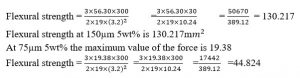
Flexural strength at 75µm 5wt% is 44.824
Brinnel Hardness Test
Table 3: At 150µm and 75µm, 5wt% filler of periwinkle shell.
| Variation | Indenter diameter D(mm) | Constant load | Depth 0f indentation d(mm) | HBN |
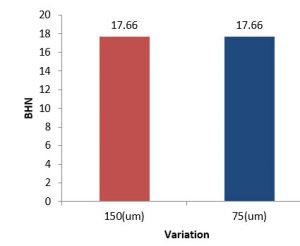
| 150µm | 10.00 | 500 | 0.88 | 17.66 |
| 75µm | 10.00 | 500 | 0.13 | 17.66 |
The summary of parameter analyzed at variation of 150µm and 75 µm, 5wt% filler of periwinkle and polypropylene composites is on the table below:
Table 4: Parameter analysis at variation of 150µm and 75 µm, 5wt% filler of periwinkle and polypropylene composites
| Variation | Tensile strength (N/ mm2) | Flexural strength (N/ mm2) |
Hardness (N/mm2) | MoE (N//mm2) | |||
| 150µm | 31.25 | 130.22 | 17.66 | 0.980 | |||
| 75µm | 13.16 | 44.82 | 17.66 | 0.972 | |||
Pictogram on parameter of Bio-Waste Polymeric Composite.
Figure 1: Tensile Strength at 150 µm and 75 µm
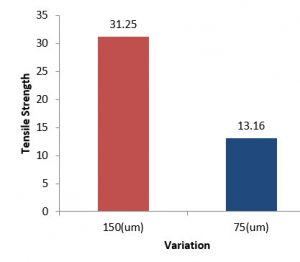
Figure 2: Flexural Strength at 150 µm and 75 µm
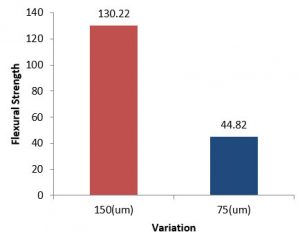
Figure 3: BHN at 150 µm and 75 µm
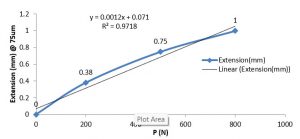
Graphical Interpretation of Tensile Strength: Extension is linearly related to load with R2 value of 0.98 at 150um, while with R2 value of 0.97 at 75um. That is, 98% and 97% variation in extension is influences by load at 150um and 75um respectively. Also, results shows that load positively influence extension (see Fig 4 & 5).
Figure 4: Tensile Test at 150 µm
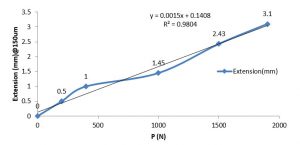
Figure 5: Tensile Test at 75 (um)
Correlation Interpretation on the Research Parameters: The Correlation result shows that 150um is significantly (p<0.05) correlated with 75um based on three parameters. This implies that the effect based on the parameter is the same.
Correlation of Variables
| 150um | 75um | ||
| 150um | Pearson Correlation | 1 | .964** |
| Sig. (2-tailed) | .008 | ||
| N | 3 | 3 | |
| 75um | Pearson Correlation | .964** | 1 |
| Sig. (2-tailed) | .008 | ||
| N | 3 | 3 | |
| **. Correlation is significant at the 0.01 level (2-tailed). | |||
DISCUSSION
Tensile strength: The polypropylene polymer matrices reinforced with periwinkle shell particle filler of 150 µm and 75µm. The result of the 75𝜋m sieve filler presented in summary table 4 and figure 1, 4 and 5 above shows the plot of stress versus strain the slope of the graph represents the modulus of elasticity (MoE) of the composite. The values of 0.98 at 150 µm and of 0.97 at 75 µm; that is, 98% and 97% variation in extension are influences by load at 150 µm and 75 µm respectively. Also, results shows that load positively influence extension. The figure shows the bar chart that depict the variation of the tensile strength is the evident that, at 150 µm sieve size filler has 31.25n while at 75 µm sieve size filler has 13.25n
The results shows that; an increase at 150 µm sieve size filler of polymer composites indicates that there is an increase in stiffness of the composites of periwinkle shell filler when resulted to increase in brittleness of the composites. For the composite at 75 µm sieved particle there was decrease in the stiffness which are likely to increase ductility of the composite material obtained, the tensile stress-strain relaxation exhibited considerable linear. This is consisted with the theory where mechanical properties in fiber direction are strongly determined by fiber a property that passes linear stress-strain relaxation up to fracture [4,5,6]. The increase in the slope was suspected caused by straightening the heavy fiber.
Flexural strength: The polypropylene polymer matric reinforced with periwinkle sieve sized particle at 150 µm and 75 µm; the effect at the 150 µm and 75 µm sieve size particle of periwinkle shell filler on the flexural strength of the polypropylene composites is shown in summary table 4 and figure 2 at 754m sieve sized particle of periwinkle cell (44.82) had reduced the flexural strength compared to 150𝜋m sieve sized particle of periwinkle (130.32). The improvement achieved by reinforcing polypropylene polymer composite on flexural strength with periwinkle shell fillers at 150𝜋m sieved particles. According to [4,5,6] the adverse effect is attributed to the inability of the filler (fiber) to be irregularly shaped in order to support stresses transferred from the polymer matrix and poor interfacial bonding, generating particles spices between the fiber and matrix material and as well as the result gives rise to weak structures. As flexural strength is one of the importance properties of the composite to be used in structural application it most possess higher flexural strength.
Brinnel Hardness: The polypropylene matrix reinforced with periwinkle sieve sized particle filler at 150 µm and 75 µm surface hardness of the composite is considered as one of the important factor that govern the wear resistance of the composites, the effects at 150 µm and 75 µm sieve sided particle filler of periwinkle shell on the brinnel hardness of the polypropylene polymer composites shown in the summary table at fig 3. It can be seen that all the filler loading of periwinkle shell in the polymer at 150 µm sieved sized (17.66N at 75 µm sieved sized (17.66N ) respectively had some value which revealed that the periwinkle shell loading at 150 µm sized particles and 70 µm sieve sized particle, the hard value of the reinforced polymer composite agree with the finding of many researchers using natural fillers to blend synthetic polymer especially with [4,5].
CONCLUSION
More than decades now, the bio-waste fiber/filler composites have attracted more important among other materials as reinforcement in the composites. The attractive features of the natural fiber /filler are there low cost, light weight, stability and good behavioral of the material, biodegradability eco-friendly nature, availability and sustainability. This project presents the fabrication from regenerated cellulose of bio-waste polymer matrix composite using periwinkle shell at 150 µm and 75 µm sieve particles filler reinforced with polypropylene (PP) composite were used to characterize tensile, flexural strength and hardness of the composite in other to gain insight into the effect of filler content on the properties. The fabrication of bio-waste thermoplastic composite using periwinkle shell reinforcement on polypropylene (PP) showed higher or better tensile strength, compressive strength, hardness and creep rate at 150 µm and 75 µm sieve sizes particle filler, it can be concluded that the filler had good degree of the interaction and indicated by the test data obtained from the bio-waste polymer composites as the particles which act as load and not only helped to stiffen the composite but also improved bending, flexibility and overall load distribution.
Statistical correlation coefficient using Pearson product moment between the sieve sizes particle filler of periwinkle on polymer matrices of stress and strain indicated a strong positive relationship between the variable. The correlation results shows that 150 µm is significantly (p<0.05) correlated with 75 µm based on three parameters; this implies that the effect based on the parameters is the same. There was significant improvement on the parameter that the fillers had good degree of interactions as indicated by the test data obtained from the bio-waste polymer composite. This was due to the particles which acted as load carrying member, not only helping to stiffen the composite but improve bending, flexibility, hardness and overall local distribution. This implies that reinforcing or fabricating bio-waste such as periwinkle shell into pure polymer matrix. Many researcher such as [4,5,6,7] [8] and salemene all agreed with the research.
Similarly, [4,5,6] demonstrated that there were great significant effects on the properties of polymer matrix composite with natural filler on polymer material than with only pure polymer for a polymer application. Also demonstrated the development of polymer-nanoparticle hybrids for antimicrobial coatings, showcasing their efficacy in inhibiting bacterial growth and preventing biofouling.
ACKNOWLEDGEMENT
This research work has come forward defining abundant combination of biodegradable matrix /natural fillers in order to promote new classes of biodegradable composite with enhanced properties as well as obtain product with lower cost, light weight, high specific strength, flexibility stability and good behavior of the materials, toughness, bio- degradability, eco-friendly nature, and availability. Also, managing of agro-waste for sustainable economy, creating job opportunities in industries and finally leads to wealth creation.
REFERENCES
- Fono –Toma, R.S and Koya, O.A (2013) .Characterrization of pulverized palm kernel shell for sustainable waste diversification, international journal of scientific and engineering, research ,4(4); 6-10.
- Ikumapayi, O.M and Akinlabi, E.T,(2020) .Composition ,characteristics and socioeconomic benefits of palm kernel shell exploitation; an overview.Journal of Environmemtal Science and Technology,11;220-232.
- Helen Obianuju Ofor, A.N Ebotu, O.I Chiaghanam, C.A Odilor, E.N Ojiako (2021) Mechanical Properties, Morphology and Elemental composition of composites produced from Acrylonitrile- Butadiene-Styrene Thermoplastics Incorporated with Cow Horn”. An International Scientific Journal; World Scientific News 160, 158-171.
- Ofor H.O (2021),” Mechanical Properties, Morphology and Elemental Composition of composites produced from Thermoplastic Polymers Filled with Egg Shell”. International Research Journal of Pure and Applied Chemistry, 22(1), 59-78
- Ofor H.O (2021),” Physico-Mechanical Properties of composites Produced from Thermoplastic Polymers Filled with Egg Shell”. Chemical Science International Journal, 28-45.
- Ofor H.O and Ojiako E.N (2019),” The Effect of Cow Horn as Filler on the Physico-Mechanical Property in Polymeric Matrices Composite”. Journal of Basic Physical Research. 9 (1) 81-90.
- Ofor H.O and Ojiako E.N (2019),” The Effect of Egg Shell as Filler on Creep Mechanical Property in Thermoplastic Polymer Matrices Composite”. ANACHEM Journal 9 (1) 1630-1644.
- Ofor H.O and Ojiako E.N (2019),” The Effect of Palm Kernel Shell as Filler on the Physico-Mechanical Property in Polymeric Matrices Composite”. Journal of Basic Physical Research. 9 (1) 71-80.
- Ojiako E.N, Ofor H.O and Nwadiogwu J.O (2019),” The Effect of Palm Kernel Shell as Filler on the Physico-Mechanical Property in Polymeric Matrices Composite”. COOU Journal of Physical Sciences. 2 (2) 101-128.
- Sapuan, SM, Pua F., El-Shekeil Y. and AL-Oqla FM (2013). ‘Mechanical properties of soil buried kenaf fibre reinforced thermoplastic polyurethane composites. Mater Des 50:467–470.
- Sapuan, M, (2010), The influence of oligomeric siloxane concentration on the mechanical behaviors of alkalized jute/modified epoxy composites.J Reinf plast compos29(6) ;807-817.